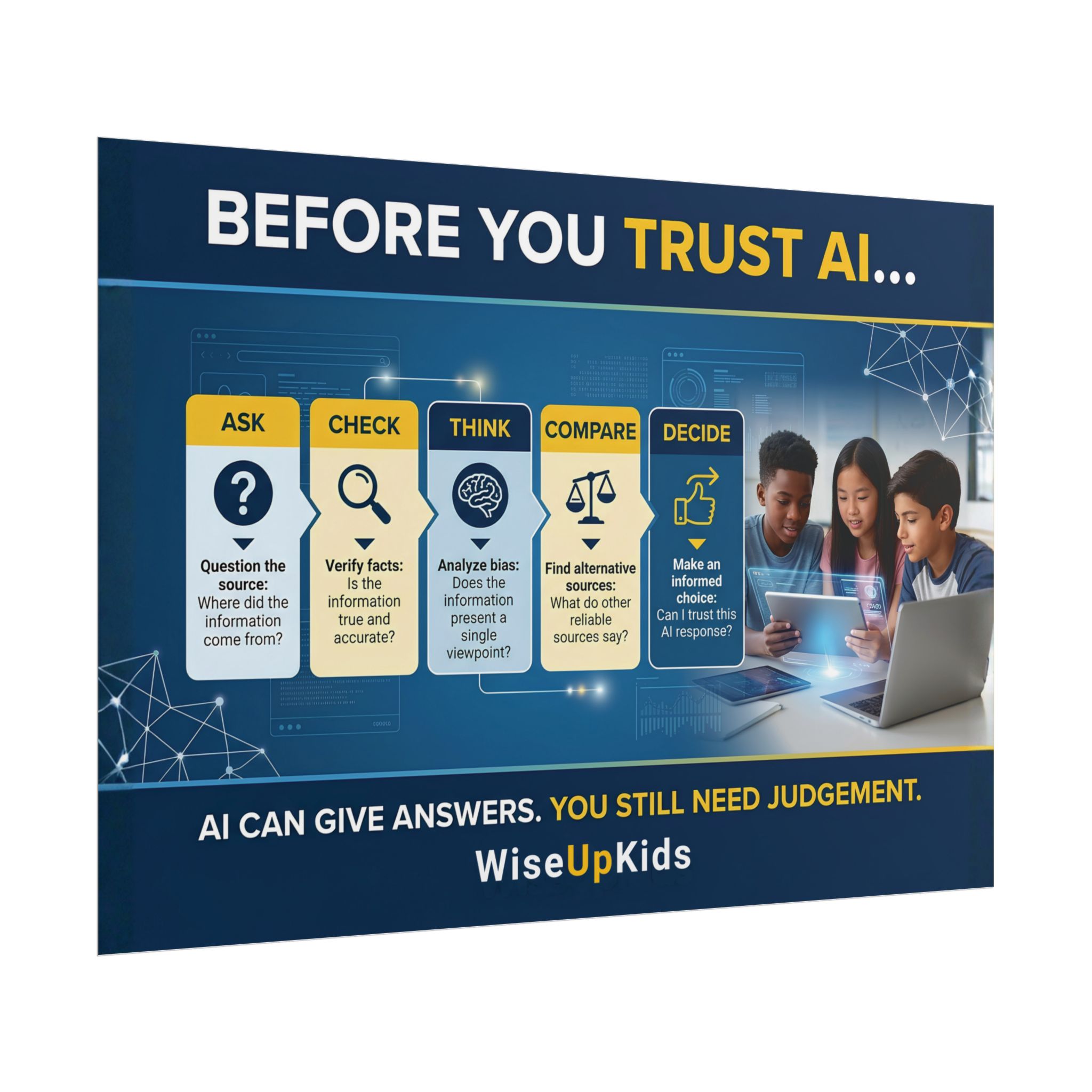
AI can answer your child. But can your child question AI?
The goal isn’t to make children scared of AI. It’s helping them use it with judgement.
Artificial intelligence is no longer a future topic for children. It is already part of everyday life.
AI is now inside search engines, homework tools, games, apps, image generators, recommendation feeds and chatbots. That can feel exciting. It can also feel unsettling.
Many parents are asking the same question: how do I talk to my child about AI without making it sound either magical or terrifying?
Can AI get things wrong?
Should children use AI for homework?
Are AI chatbots safe for children?
AI Can Be Useful
It can explain tricky words, suggest ideas, summarise information, create images and help children explore new topics.
AI Can Be Wrong
It can misunderstand, invent, guess, miss context, repeat bias or make a wrong answer sound very believable.
That is why AI literacy is not only a technology skill. It is a thinking skill.
Children need to understand that AI can be helpful without being in charge. It can give answers, but it does not get the final say.
What Is AI, in Child-Friendly Language?
A simple explanation is: AI is computer technology that can spot patterns and make predictions. It can write, answer, sort, suggest, draw or summarise by learning from lots of examples.
For younger children, you might say: “AI is a computer tool that guesses what might be useful based on patterns it has seen before. Sometimes it is helpful. Sometimes it gets things wrong.”
The Three-Question AI Check
How would I know this is true?
Where else could I check it?
What might be missing?
Why Children May Trust AI Too Quickly
AI tools often sound polished, calm and confident. That can make children believe the answer must be true.
Adults do this too. When something is written clearly, we often mistake clarity for accuracy. Children may be especially vulnerable because they are still learning how to check sources, compare evidence and understand when something is opinion, prediction or fact.
Can AI Get Things Wrong?
Yes. AI can invent facts, misunderstand a question, give outdated information, miss context, reflect bias, produce unsafe advice or make a wrong answer sound very believable.
This is sometimes called an AI hallucination. For children, a simpler explanation is: “Sometimes AI fills in the gaps and guesses. The problem is that it can make a guess look like a fact.”
Should Children Use AI for Homework?
AI can help with learning when it is used as a support tool. It can explain a tricky word, suggest practice questions, summarise a topic or help a child understand a concept in a different way.
But there is a difference between using AI to learn and using AI to avoid thinking.
Helpful: “Explain this idea in simpler words.”
Helpful: “Give me three practice questions.”
Not helpful: “Write my homework for me.”
Not helpful: “Make it look like I did the work.”
What About AI Chatbots?
AI chatbots can feel very human because they respond quickly, remember parts of a conversation and use friendly language.
This is where parents need to be especially careful. A child may start to treat a chatbot like a friend, adviser or secret keeper. That can be risky if the child shares personal information, asks for emotional advice, follows unsafe suggestions or starts relying on the chatbot instead of trusted people.
A chatbot is not a real friend.
A chatbot is not a private diary.
A chatbot is not a therapist.
A chatbot should not be asked to keep secrets from parents or carers.
Privacy Rules for Children Using AI
Before a child uses any AI tool, they should know what not to share: full name, address, school name, phone number, email address, passwords, location, private family information, or photos and videos without permission.
A simple rule is: “If you would not put it on a poster outside school, do not type it into an AI tool.”
How to Explain Bias in AI
Bias can sound like an adult word, but children can understand it through examples.
You might say: “If a computer learns from lots of examples, and those examples are unfair or incomplete, the computer can repeat unfair or incomplete ideas.”
This is why children should ask: whose view is included, whose view might be missing, and is this a fact, an opinion or a prediction?
Five Family Rules for Safer AI Use
We use AI as a tool, not as the boss.
We do not share private information with AI tools.
We check important answers with another source.
We do not copy AI answers and pretend they are our own work.
We talk to a real person if something feels confusing, upsetting or unsafe.
What Parents Can Say
Instead of “AI is dangerous,” try: “AI can be useful, but it needs questioning.”
Instead of “Do not use it,” try: “Let’s learn how to use it properly before you rely on it.”
Instead of “AI knows everything,” try: “AI can give answers, but we still need to check whether they are true.”
A Child-Friendly AI Activity
Ask an AI tool a simple question together, such as: “What are three facts about dolphins?”
Then ask your child: which parts sound factual, where could we check them, could anything be missing, does the answer tell us where the information came from, and would we trust this for homework without checking?
When to Step In
Parents should step in if a child uses AI secretly in worrying ways, shares private information, treats a chatbot as a best friend or emotional replacement, receives upsetting content, uses AI to avoid schoolwork, or becomes distressed by something an AI tool says.
Try to respond calmly where possible. A useful phrase is: “Thank you for telling me. We can sort this together.”
The WiseUpKids View
AI is not going away. Children will grow up with tools that can answer, generate, recommend, persuade and imitate.
The answer is not to pretend AI does not exist. It is also not to hand children powerful tools without guidance. The middle path is better: teach children what AI is, what it is not, how to check it, how to protect private information and why their own thinking still matters.
AI can give answers.
But children still need to learn how to ask better questions.
Sources and Further Reading
This article should be read alongside current guidance from trusted child-safety, media-literacy and education organisations:
Ofcom – children’s media use and AI trust findings
GOV.UK – Growing up in the online world consultation
OECD – artificial intelligence, education and skills
AI Literacy Framework
NSPCC – AI safety tips for parents
Get Curious
Continue the conversation with these related articles.

What Age Should Children Get Social Media?
Social media readiness is not just about age. It is about judgement, pressure, privacy and whether a child knows when to ask for help..
Can AI Get Things Wrong?
Why chatbots sometimes make mistakes and why checking information still matters.
Will AI Replace Thinking?
AI can give answers, but children still need judgement, curiosity and independent thinking.